
Tealeaks: Down with the Old
An observation and suggestions on new approach to Nepal China from a Gen-Z

Welcome to The Araniko Project’s Tealeaks series. Tealeaks is a series of short, thinking-out-loud reflections on life under the Nepal–China sky, and occasionally to South Asia-China as well. Each of our articles will be brief, like a sip, but meant to leave a lingering taste: from fresh new ideas to challenging perspectives. You can proceed here to find more about our past articles under Tealeaks and our objective of running it.
Before proceeding, consider supporting The Araniko Project by becoming our paid subscriber. We are a hundred percent reader supported newsletter and the only one based from Nepal that invests in research, studying and writing on China from within China. Readers can subscribe with $100(Rs 10,000) annually or $10(Rs 1000) monthly membership.

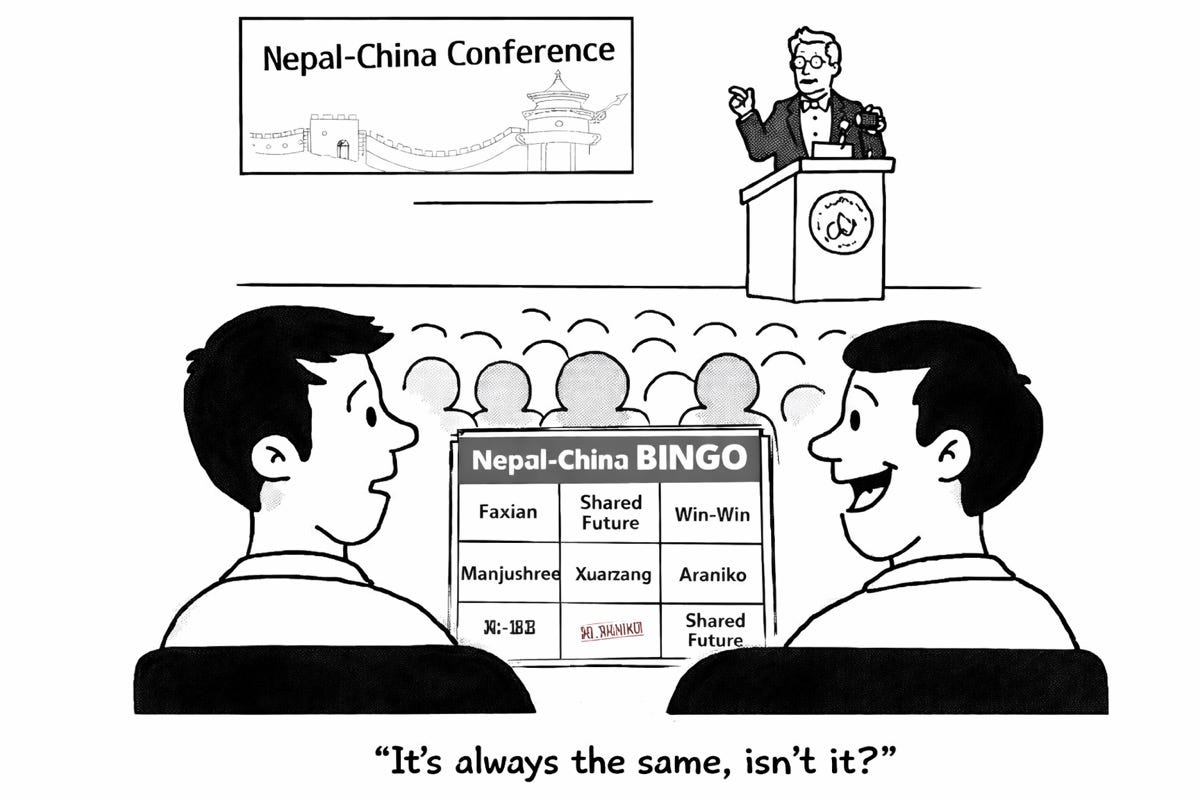
Two years ago, due to prior commitments, I missed an event in Kathmandu organized by a Nepali organization supported by some Chinese institution on topic of Nepal-China relations. Shortly after, I met a Chinese friend who had attended the event. Before I even asked, he shared his impressions, which only confirmed my own assumptions. This was his first event and his first experience of Nepal and his observations were simple: The presentations were underwhelming, if not outright dull. Most of the audience, including the speakers, were noticeably older. He asked me, quite sincerely, “Is it always like this? Where are the Nepali youth?”
Before answering him, some context is necessary. Over the years, I’m grateful to have attended many academic events on China inside Nepal, both critical and not. While I work in the China field, I often find myself missing Chinese cultural and literary events altogether. Where are they promoted? Who is invited? Why do they surface only in obscure online portals with barely any readership?
I’m not only asking these questions but I get them too.
Six years ago, I was undergraduate student at Peking University. A billboard towards the corner of the theatre building which had Chinese characters written Tibetan-looking font caught my attention. I looked close to realize it was a poster of the Nepali musical band Sur Suda playing the same night. As a student assistant at the International Students Division, I was lucky to secure a ticket for me and a fellow Nepali student for the event at night. However, neither the Nepali Embassy in Beijing nor the university bothered to inform the small group of Nepali students on campus. I was highly disappointed that evening.
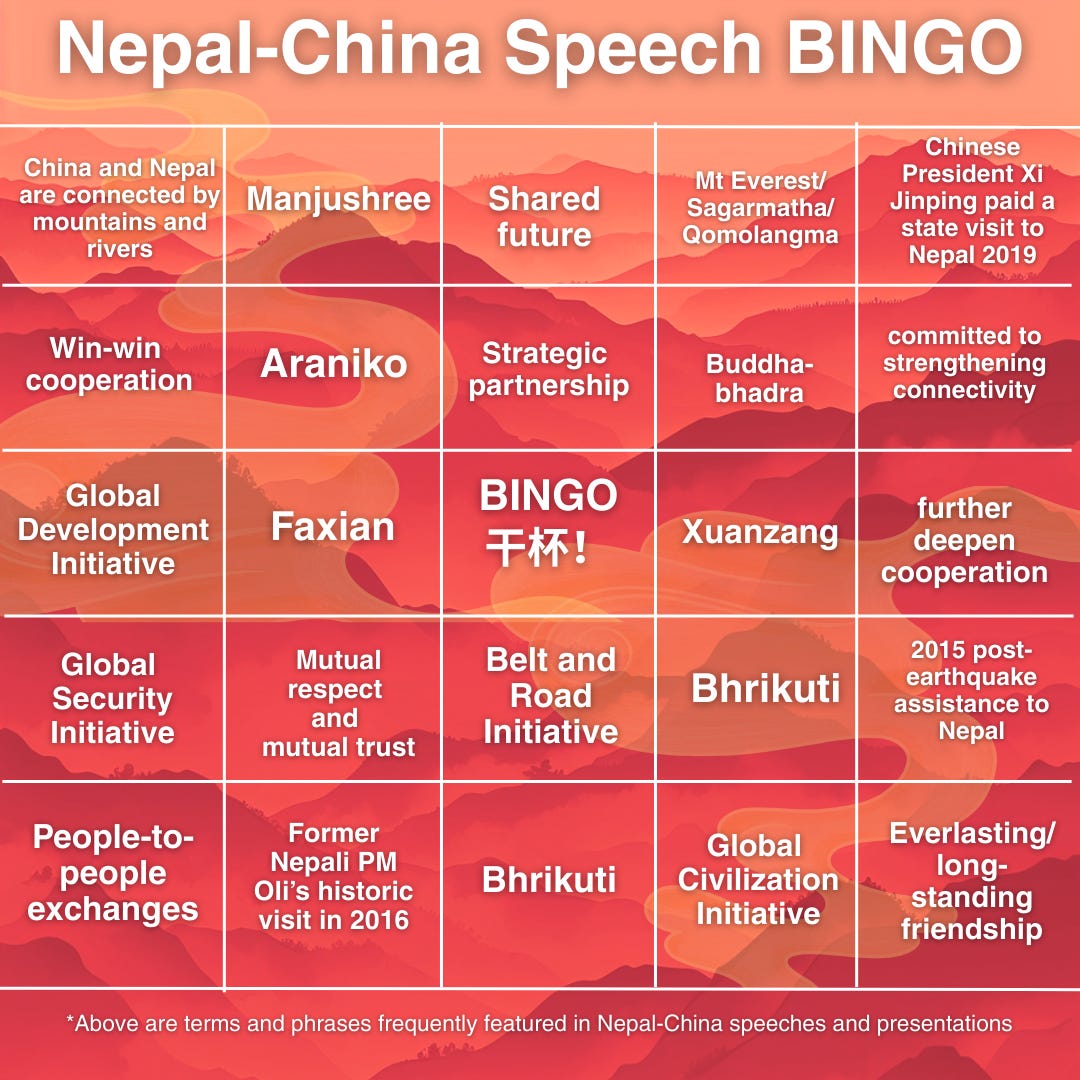
I was stuck in Nepal due to COVID and every time I attend a Nepal-China event supported by the China (of course China) I find myself listening to the same familiar Nepali personalities. Many fall into a predictable category: graduated in STEM from China, performing as part-time Sinologists, or having traveled to China almost every few months without ever bothering to even learn Mandarin (if a name comes to your mind, they’re most likely a part of this). What is most disheartening is how effectively they manage to make one of the most fascinating countries and bilateral relationships sound so boring. Every speech or presentation on Nepal-China relations could make a Bingo within 5 mins of it with frequent buzzwords like Manjushree, Faxian, Bhrikuti, Araniko, Xuanzang, “Shared future.” “Win-win cooperation”. None of it is enough to make people look up from their screens anymore.
An academic event I attended in Beijing left me distraught by how little we value young talent and intellects among us as we all listened to all Nepali speakers online except one and all Chinese speakers in person buried under their script except one who claims to be a Nepal expert without the language and went off script to instruct Nepali professionals and diplomats to learn Chinese as soon as possible.
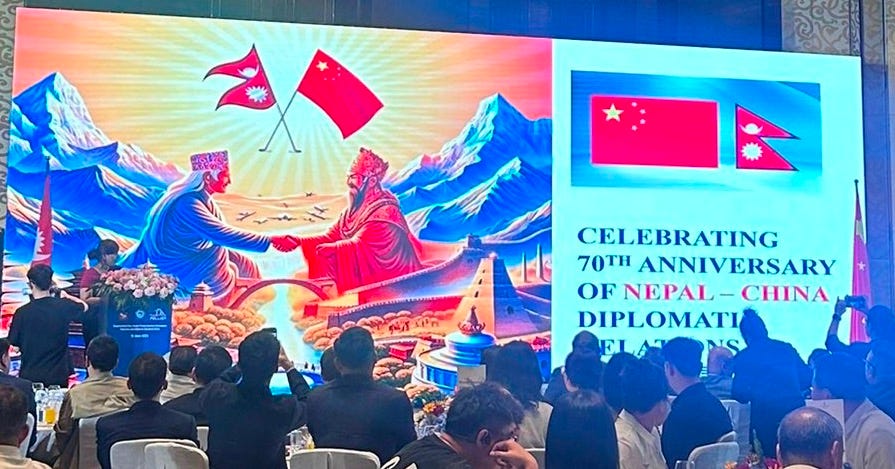
The problem here is the old way of doing things and the monopoly by the older generation. The unwillingness to update themselves with the latest news and trends, understand China from within, find innovative ways to present and most importantly, make space and mentor the upcoming generation. Coming back to China in 2024, after three years of being in Nepal, and reflecting back what I’ve heard from Nepal’s “China experts”, I can’t help but noticed how outdated most presentations were and now vaguely they interpret Chinese governance and concepts. These events may be ticking boxes, but they end up making China appear more distant and mysterious than it needs to be. Similarly, Nepal also keeps its standard ground-low in introducing itself in China. The Nepal Tourism Board presentation in Beijing in June 2025 opened with an awkward AI-generated cover image of Nepal–China relations and continued with a lazy and largely untranslated presentation, which genuinely horrified me and prompted me to voice my discomfort openly at a table of Nepali students in Beijing. When a Nepali PhD student next to me remarked that she thought the presentation was pretty good, a comment that revealed how impressively low our standards have become.
Having received the opportunity to study China in China, my opinion and suggestions can only come from a place of expectation, hope and recognition of China’s ability that I’ve witnessed from inside. Nepal is approaching what may be the most consequential election in the contemporary political lives of many Gen Z individuals like mine on 5 March 2026. China must prepare for a reality in which younger Nepalis are more active in politics and civic life than ever before. The Gen-Z movement, has made way for the younger generation to be recognized.
The general knowledge in Nepal is that China or more specifically the Communist Party of China is more comfortable with the many communist parties of Nepal but thats also because the communist parties not only have the capacity and experience to deal with China but are also rather proactive. Hence, we often hear about their various exchanges to China. Now, with the main three political parties who have been ruling non-stop having the worst impression in history, China’s engagement with them poses challenges for its image for the younger generation aka the future of Nepal. They’ll have to choose between diversifying their friends circle, being more inclusive of ages, genders and other backgrounds, and fostering quality talent, or rather squeezing their circle and building a higher wall. Meanwhile, I hope in China or Chinese institutions in Nepal, there is a sense of recognition that most of the personalities they’ve surrounded themselves with have, mostly, have become sycophants and build an alternative reality which leaves them out of touch with reality.
To answer my first question: Where are the Nepali youth in these spaces?
the Nepali youth are everywhere but discouraged by opportunities that go to other Nepali youth who are more equal than the others, discouraged by older and more connected older people, discouraged by not being recognized by authorities for their curiosity and contributions and finally, discouraged by the unwillingness to be inclusive and open-minded.
To Chinese authorities working in Nepal, and to Nepali authorities both at home and in China, the message is a shared one. Diversify your circles. Invest in the next generation. Recognize potential before it turns into indifference. Create pathways for younger Nepalis to experience China meaningfully, support serious China studies at home, facilitate Chinese students studying Nepal(i) in China and Nepal, and take communication and outreach seriously in the spaces where young people already are both offline and online. Confucius, who is routinely invoked in Chinese discussions whether one asks for him or not, observed that 君子和而不同: Genuine harmony is not built through sameness, but through the confidence to engage across difference.